
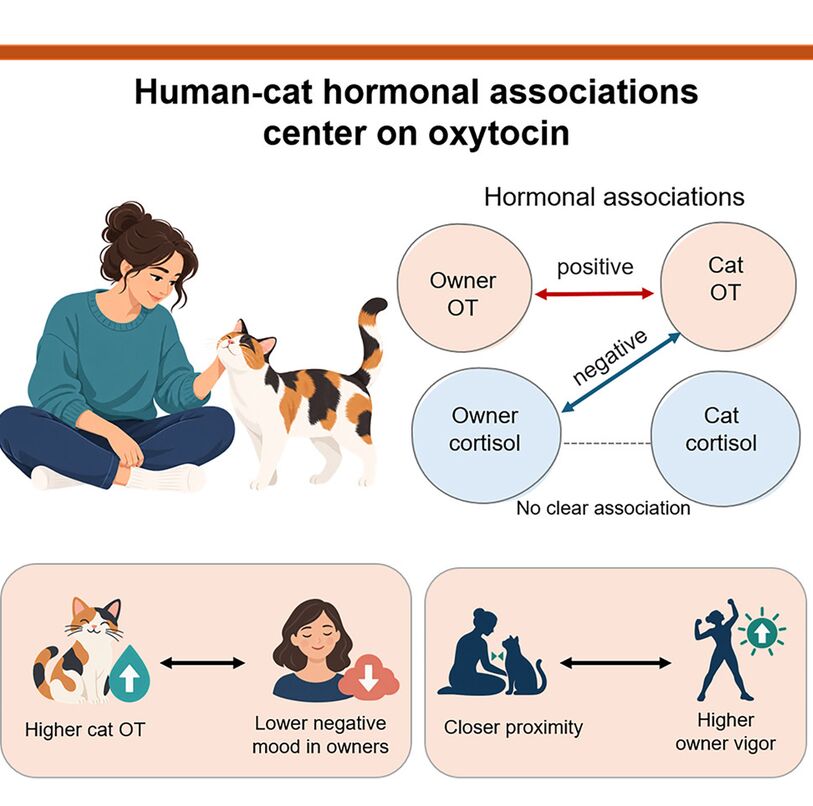
A new recent paper, Cats and humans show correlated affiliative physiological states (Takagi et al., 2026), investigates whether cats and their owners share related hormonal states and whether physical proximity between them is associated with owners’ psychological wellbeing.
A particularly interesting aspect is the use of Bluetooth Low Energy (BLE) beacons to objectively measure how close cats and their owners were during everyday life, rather than relying on questionnaires or owners’ recollections.
The researchers studied 29 cats belonging to 19 owners over a one-month period. Each cat wore a small BLE beacon continuously, 24 hours a day, for one month. The beacons were attached either in a protective case fitted to a standard collar or incorporated into a modified bandana-style collar.
Each owner received a dedicated smartphone running a custom-developed application that recorded the Bluetooth signal strength received from their cat’s beacon. The owners were instructed to carry the smartphone while at home, switch it off and leave it near the entrance when going out, and switch it back on when returning. Overnight, the phone was charged near their usual sleeping position.
The system therefore measured proximity between the cat’s collar and the owner’s smartphone during periods when the owner was at home, rather than continuously tracking the cat’s geographical location.
The researchers used Received Signal Strength Indicator (RSSI) measurements, expressed in decibel-milliwatts (dBm), as an indicator of distance. Readings weaker than −90 dBm were discarded because the researchers considered them unreliable indicators of distance. Rather than converting the readings into precise distances in metres, the researchers calculated the median RSSI value for each cat-owner pair across the month. This produced a single proximity measure for each pair, with higher RSSI values indicating closer proximity. Using the median helped reduce the influence of fluctuations and noise in the Bluetooth measurements.
The most important beacon-related finding was that closer physical proximity between owners and their cats was associated with higher scores for Vigor-Activity, a psychological measure reflecting energy, enthusiasm and vitality. The reported standardised association was 0.46, with a 95% credible interval of 0.12 to 0.82. The relationship remained supported when the researchers repeated the analysis at household level (0.55, 95% credible interval 0.11 to 0.99).
By contrast, the length of time someone had owned their cat did not show a similarly robust association with positive mood. This suggests that everyday closeness to a cat may be more relevant to an owner’s positive emotional state than simply having lived with the animal for a long period.
Alongside the Bluetooth monitoring, the researchers collected urine samples to measure oxytocin, associated with social bonding, and cortisol, associated with stress. They found that owners and cats had positively correlated oxytocin concentrations. Higher cat oxytocin was also associated with lower owner cortisol and several measures of reduced negative mood. A separate behavioural test indicated that cats with higher oxytocin levels were more likely to approach people.
The main conclusion is that Bluetooth beacons provided a practical way to measure everyday physical closeness between cats and humans, and that this closeness was associated with greater owner vitality. The findings support the value of objective proximity monitoring in human-animal interaction research.