
A new paper, Stochastic and functional modeling of RSSI measurements for accurate distance estimation in Bluetooth Low Energy–based indoor positioning, proposes a more statistically rigorous way of using Bluetooth Low Energy (BLE) signal strength to estimate distance. Its main argument is that Received Signal Strength Indicator (RSSI) measurements should not be treated as independent, random observations. Instead, RSSI errors are temporally correlated, or “coloured noise”, and this correlation needs to be modelled if reliable distances and uncertainty estimates are required.
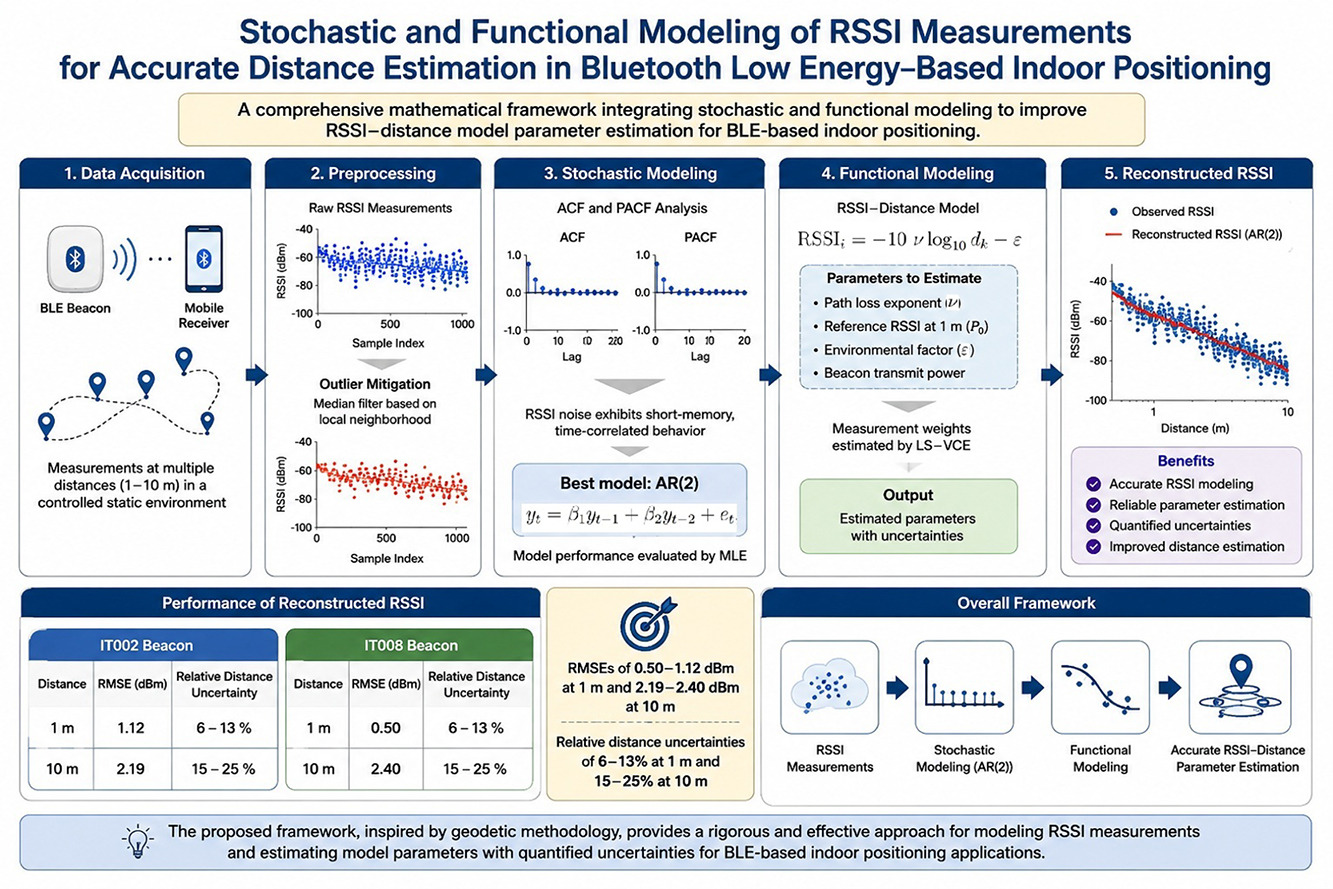
The authors combine two types of modelling. First, they perform stochastic modelling to describe the behaviour of RSSI noise. Outliers are removed using a median filter, then the autocorrelation function (ACF) and partial autocorrelation function (PACF) are used to examine how successive RSSI observations depend on one another. These analyses indicate that an AR(2), or second-order autoregressive, process provides an appropriate model. The resulting covariance structure is then incorporated into Least Squares Variance Component Estimation (LS-VCE), which estimates realistic variances and measurement weights. Secondly, a functional RSSI–distance model is fitted using Best Linear Unbiased Estimation (BLUE), estimating both the environmental path-loss factor and beacon transmission-power parameter along with their uncertainties.
The experiment used two Tatwah BLE beacons, the IT002 and IT008, with a Samsung Galaxy S22+ as the receiver. RSSI measurements were collected for 20 minutes at 0.5 Hz at fixed separations of 1, 3, 5 and 10 metres. Importantly, the tests were carried out in a controlled outdoor environment rather than a normal indoor environment so that interference and multipath effects could be minimised and the intrinsic RSSI behaviour studied more cleanly.
The results strongly support the authors’ claim that RSSI noise is not white noise. Also, more distant measurements should receive less weight during model calibration.
The paper’s main contribution is not a new positioning algorithm itself, but a better statistical foundation for RSSI-based ranging. Instead of simply smoothing RSSI and fitting a distance equation, it explicitly models temporal correlation, calculates realistic measurement weights and uncertainty, and then estimates the RSSI–distance relationship. The authors conclude that this produces more statistically consistent calibration and more reliable BLE distance estimates.