
New research presents RELoc, a WiFi fingerprinting indoor localisation framework designed to work reliably in multi-floor buildings where conventional 2D approaches often struggle because they cannot properly resolve vertical (between-floor) ambiguity. The method combines Recursive Feature Elimination with Cross-Validation (RFECV) to select the most informative WiFi access point signals, and an Extremely Randomised Trees regressor to predict positions as either 2D coordinates or full 3D coordinates including floor information. The trees model is tuned using Bayesian hyperparameter optimisation via Optuna’s Tree-structured Parzen Estimator, with the aim of improving accuracy while keeping computation manageable for practical deployments.
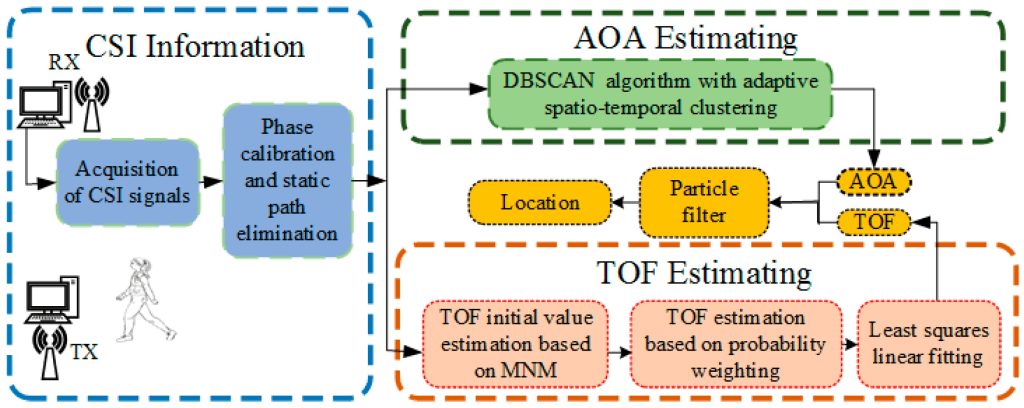
The authors evaluate RELoc on two public datasets, SODIndoorLoc and UTSIndoorLoc, and report that the 2D version achieves mean absolute errors of 1.84 m (SODIndoorLoc) and 4.39 m (UTSIndoorLoc). When floor level is incorporated for 3D prediction, performance improves markedly compared with the corresponding 2D setup, reducing error by about a third on SODIndoorLoc and by just over a quarter on UTSIndoorLoc, which the paper attributes to 3D modelling’s ability to separate locations that look similar in WiFi signal strength in the horizontal plane but lie on different floors. Across both datasets, the reported results show RELoc outperforming a range of baseline machine learning, ensemble, and deep learning methods, while also training faster than heavier neural approaches in their experiments.
The paper concludes that combining cross-validated feature selection with an efficient tree ensemble and automated tuning produces a strong balance of accuracy and computational efficiency for multi-floor indoor positioning.