
New research proposes a low-infrastructure way to detect whether a freight wagon has entered or exited a station control point using Bluetooth Low Energy RSSI signals. The system uses Eddystone-TLM BLE beacons mounted on wagon bodies and two fixed BLE gateways placed about 15 metres apart. As the metal wagon body passes between the gateways, it shields and delays the received signal in a direction-dependent way. The authors use this asymmetry to infer direction without needing trained machine-learning models, site-specific calibration, axle counters, RFID gates, cameras, or track modifications.
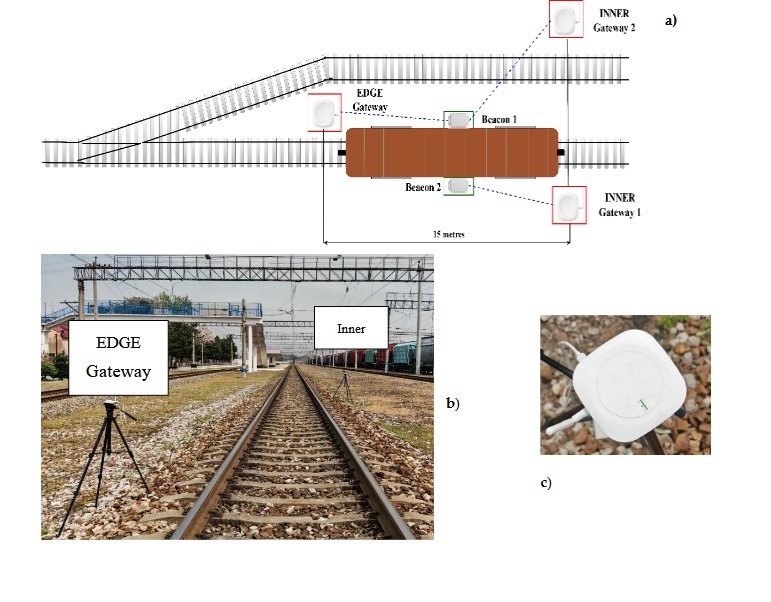
The core innovation is a five-stage signal-processing pipeline. It first detects a likely wagon-passage event using adaptive CUSUM change-point detection, merges fragmented windows, rejects partial or lateral passes, and then classifies direction using a speed-normalised Temporal Centroid shift. For difficult short or high-speed events, it falls back to peak-time and amplitude-based checks. The method is designed to run online with low memory use, making it suitable for embedded deployment at railway control points.
The evaluation covers 151 labelled events collected at Urtaul freight station and a university test polygon, including forward movements, backward movements, higher-speed forward passes, partial approaches, reversals, and lateral paths. The reported overall accuracy is 96.7%, with all 84 true directional events classified in the correct direction and no forward/backward reversals. The main weakness is the “Before-edge” case, where a wagon approaches near the first gateway and reverses; this category achieved 75% accuracy and accounted for all five errors.
The paper’s practical value is that it turns existing or proposed wagon-mounted BLE telemetry beacons into a dual-use sensing system: the beacon MAC address identifies the wagon, while the RSSI pattern gives the direction of movement. This could help station management systems maintain real-time wagon occupancy records.