
A new study develops a safety system that uses Bluetooth Low Energy (BLE) beacons to detect when a child boards or leaves a school transport vehicle. Each child carries a small BLE beacon, while the teacher’s smartphone or tablet continuously scans for its signal. The system uses the beacon’s unique address to identify the child and then sends the boarding or alighting status to the parent’s phone through a push notification.
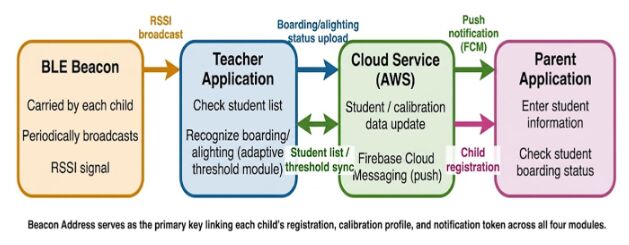
The beacon is used mainly as a proximity sensor rather than for precise positioning. The system measures RSSI, which represents the strength of the Bluetooth signal received by the teacher’s device. A stronger signal generally means the beacon is closer, while a weaker signal suggests it is further away. Because RSSI can fluctuate due to distance, vehicle layout, obstacles and orientation, the researchers do not rely on a single signal-strength threshold. Instead, they analyse ten recent RSSI readings and calculate the average, trend and variance. A lightweight logistic-regression model then decides whether the child has boarded or left the vehicle.
The system was tested in three vehicle sizes. A conventional fixed RSSI threshold worked well within about four metres, but accuracy declined at longer distances. The machine-learning approach improved accuracy from 88% to 94% at 4–5 metres and from 76% to 87% beyond five metres.
Overall, the research shows how simple, low-cost BLE beacons can be used for automatic boarding and alighting detection without modifying the vehicle or requiring the child or teacher to scan or press anything. The main limitation is that Bluetooth signal strength becomes less reliable over longer distances, so vehicle-specific calibration is still required.