Bluetooth Beacon-Based Child Boarding and Alighting Detection

A new study develops a safety system that uses Bluetooth Low Energy (BLE) beacons to detect when a child boards or leaves a school transport vehicle. Each child carries a small BLE beacon, while the teacher’s smartphone or tablet continuously scans for its signal. The system uses the beacon’s unique address to identify the child and then sends the boarding or alighting status to the parent’s phone through a push notification.
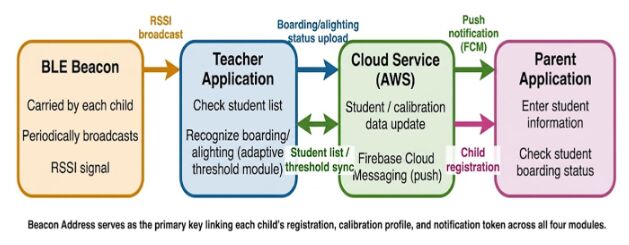

The beacon is used mainly as a proximity sensor rather than for precise positioning. The system measures RSSI, which represents the strength of the Bluetooth signal received by the teacher’s device. A stronger signal generally means the beacon is closer, while a weaker signal suggests it is further away. Because RSSI can fluctuate due to distance, vehicle layout, obstacles and orientation, the researchers do not rely on a single signal-strength threshold. Instead, they analyse ten recent RSSI readings and calculate the average, trend and variance. A lightweight logistic-regression model then decides whether the child has boarded or left the vehicle.

The system was tested in three vehicle sizes. A conventional fixed RSSI threshold worked well within about four metres, but accuracy declined at longer distances. The machine-learning approach improved accuracy from 88% to 94% at 4–5 metres and from 76% to 87% beyond five metres.

Overall, the research shows how simple, low-cost BLE beacons can be used for automatic boarding and alighting detection without modifying the vehicle or requiring the child or teacher to scan or press anything. The main limitation is that Bluetooth signal strength becomes less reliable over longer distances, so vehicle-specific calibration is still required.
Training-Free BLE Beacon Detection of Freight Wagon Direction at Railway Control Points

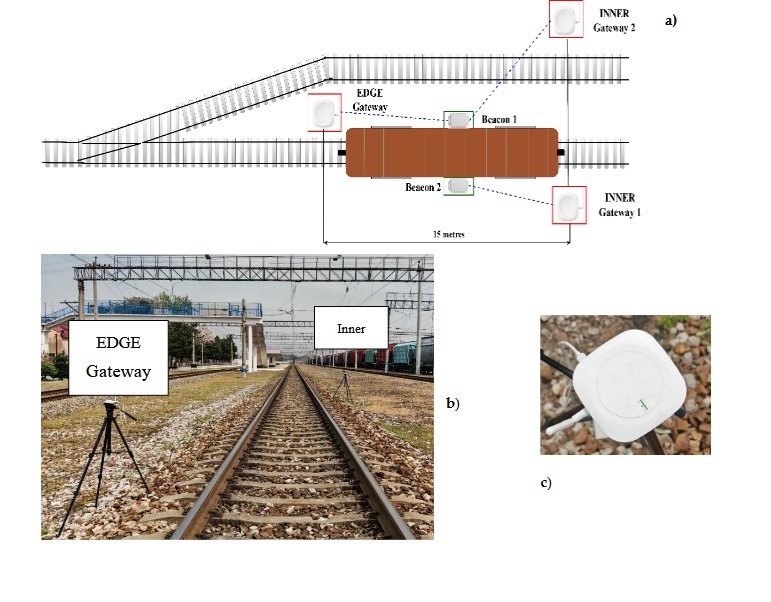
New research proposes a low-infrastructure way to detect whether a freight wagon has entered or exited a station control point using Bluetooth Low Energy RSSI signals. The system uses Eddystone-TLM BLE beacons mounted on wagon bodies and two fixed BLE gateways placed about 15 metres apart. As the metal wagon body passes between the gateways, it shields and delays the received signal in a direction-dependent way. The authors use this asymmetry to infer direction without needing trained machine-learning models, site-specific calibration, axle counters, RFID gates, cameras, or track modifications.

The core innovation is a five-stage signal-processing pipeline. It first detects a likely wagon-passage event using adaptive CUSUM change-point detection, merges fragmented windows, rejects partial or lateral passes, and then classifies direction using a speed-normalised Temporal Centroid shift. For difficult short or high-speed events, it falls back to peak-time and amplitude-based checks. The method is designed to run online with low memory use, making it suitable for embedded deployment at railway control points.

The evaluation covers 151 labelled events collected at Urtaul freight station and a university test polygon, including forward movements, backward movements, higher-speed forward passes, partial approaches, reversals, and lateral paths. The reported overall accuracy is 96.7%, with all 84 true directional events classified in the correct direction and no forward/backward reversals. The main weakness is the “Before-edge” case, where a wagon approaches near the first gateway and reverses; this category achieved 75% accuracy and accounted for all five errors.

The paper’s practical value is that it turns existing or proposed wagon-mounted BLE telemetry beacons into a dual-use sensing system: the beacon MAC address identifies the wagon, while the RSSI pattern gives the direction of movement. This could help station management systems maintain real-time wagon occupancy records.

City of Luxembourg is Using iBeacons

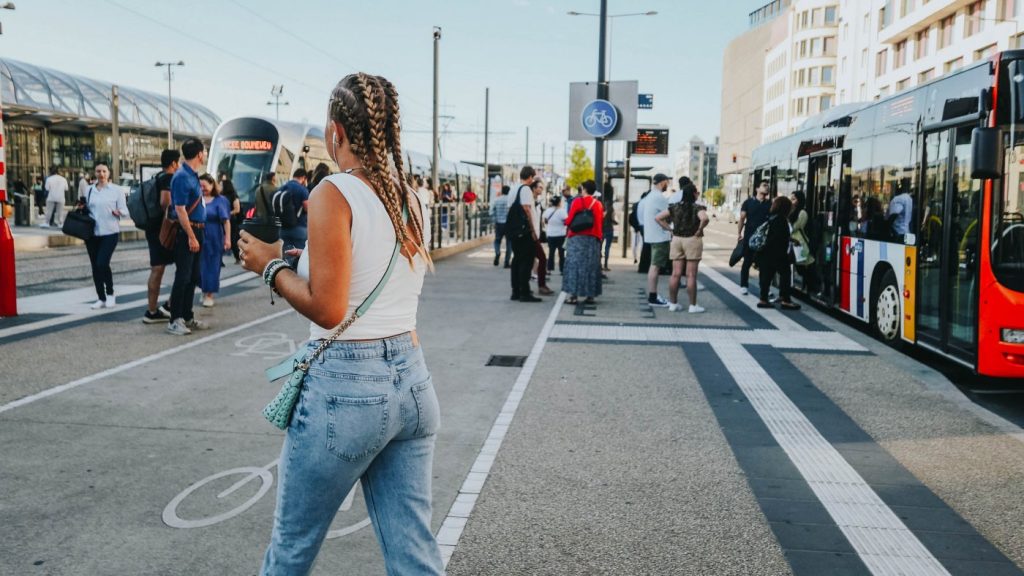
The City of Luxembourg’s Municipal Office is using Bluetooth beacons to send push notifications through its free smartphone app, cityapp – VDL, alerting users when their bus is about to depart.

The app, available in English, French and German, has several features across different tabs. The “Explore” tab highlights nearby attractions and upcoming events tailored to your preferences, such as parks, playgrounds, museums and sports facilities. The “Transport” tab offers comprehensive travel information, including real-time bus and tram departures, car park availability, cycling infrastructure, taxi ranks and service disruptions. The “Services” tab gives quick access to practical information, such as city department contacts, public toilets, water fountains, the latest city news, your waste collection schedule and forms for reporting issues or making suggestions.

The Potential of BLE Beacons in Enhancing Road Safety

Road traffic accidents have been steadily increasing, raising concerns among authorities and the public alike. A significant number of these accidents can be attributed to factors such as driver error and a blatant disregard for obeying traffic signs. While these human-induced errors persist, there is a hope on the horizon in the form of Connected and Automated Vehicles (CAVs). These vehicles, equipped with advanced technology, are anticipated to drastically reduce the number of accidents by navigating roads more safely and efficiently than traditional vehicles.

A component in the deployment and effectiveness of CAVs is Vehicle-to-everything (V2X) communication. This encompasses infrastructure-to-vehicle (I2V) and vehicle-to-vehicle (V2V) communication, acting as a bridge to enhance road safety for vehicles driven both manually by humans and automatically by systems. These modes of communication ensure that vehicles are constantly in touch with their surroundings, be it other vehicles or the infrastructure, allowing them to make informed decisions.

Enter Bluetooth Low Energy (BLE) beacons, a technology that holds significant potential for I2V communication. Their appeal lies in their affordability, compactness, low energy consumption, wide compatibility with contemporary devices, and an impressively extensive range. Given these attributes, there’s growing interest in evaluating BLE beacons’ efficacy when used as roadside units (RSUs) attached to traffic signs. The goal? To seamlessly convey time-critical information to vehicles, especially in bustling urban settings.

A comprehensive study was conducted to look into this very potential. This involved integrating a CAV development platform to discern if the vehicle could aptly receive the beacon message from a distance that allows for sufficient reaction time, especially when adhering to the speed limits set for that particular road. The study was meticulous, taking into account the road’s geometry and the varying conditions it might present, from dry surfaces to wet terrains.

Furthermore, this research wasn’t just limited to understanding the capability of BLE beacons. It also looked into testing diverse BLE beacon configurations to pinpoint the optimal setup that ensured the required distance was met for all signs. This was imperative to ensure that CAVs could safely detect the signs and respond accordingly.

The findings were promising. The results demonstrated that BLE beacons, when positioned and configured appropriately, have immense potential to be employed in time-sensitive I2V communications on urban roads. Moreover, the study succeeded in identifying the optimal beacon configurations for signs, ensuring they are detected safely by CAVs, marking a significant stride towards safer urban roads in the future.

Beacons, IoT and Transport Monitoring

Beacons are often mentioned as being IoT devices. IoT devices tend to measure and monitor performance and store data in some Big Data way. The Massachusetts Institute of Technology, Singapore MIT Alliance for Research and Technology and Technical University of Denmark have a paper on Combining Smartphone and iBeacon Technologies in a Transit Quality Survey.

Their proof of concept shows how, what looks like a transport end-user survey, can be additionally used to track service data and monitor performance on transit trips.

The paper has a few insights into the use of beacons. They found that the RSSI and proximity accuracy were affected by the number of people in the surrounding environment such that it was best to place the beacons at high positions at bus stops. They also found they needed to explictly ask users to manually enable Bluetooth on their phones.

They also consider problems that will be experienced if the proof of concept were to be scaled, in particular the dependency on having a wide set of beacon-equipped stops.

If the ultimate vision is to develop a platform for a city’s entire bus network, it may be impractical to install and maintain iBeacons at every bus stop.

There’s also mention of the need for more effective incentives to sustain participation, such as offering reward points or fare discounts.

South Western Railway Trials Beacon App for Partially Sighted Passengers

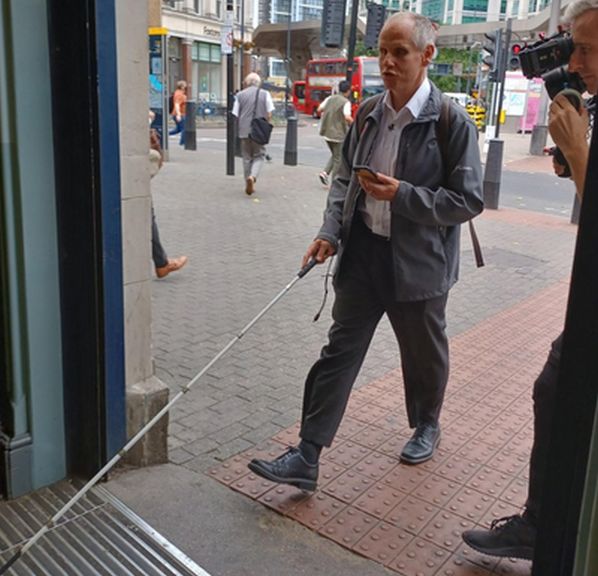
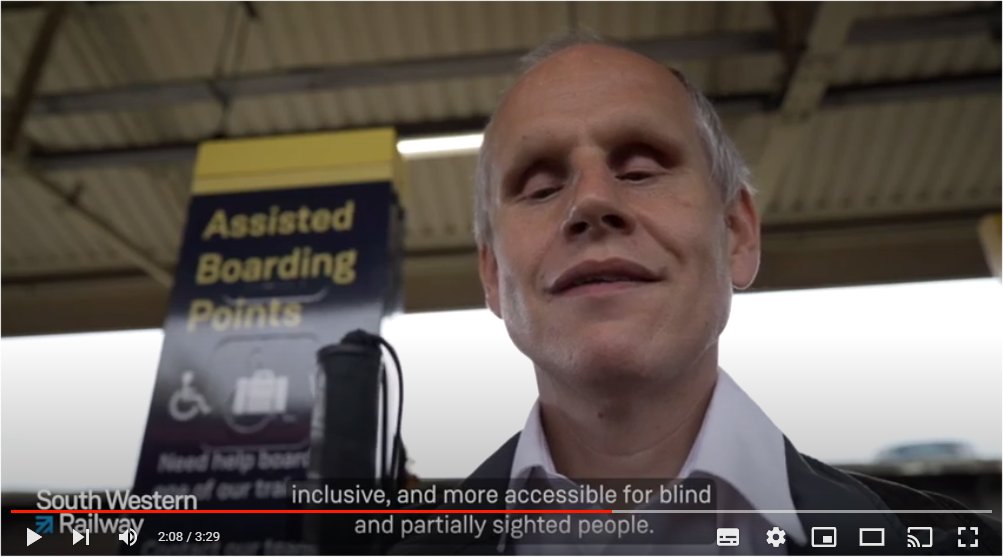
South Western Railway in Southern England is using the myEyes app to guide partially sighted users to assistance boarding points at stations. The app provides audio directions to guide passengers from the station entrance to Assisted Boarding Points on platforms.

A confusing article on the South Western Railway site attempts to explain how it works. It says “the myEyes app uses Near Field Technology to guide customers with sight loss around stations”. This isn’t true because Near Field Technology (NFC) isn’t used. It uses a smartphone’s GPS to know the passenger has reached a station and then Bluetooth beacons within the station. The article says “Bluetooth beacons installed across the station track the device in question”. This also isn’t true because it’s the wrong way around. The smartphone detects the beacons to know a passenger’s location.

A video is available showing the app being used.

Automatic Transport Ticketing Using Beacons

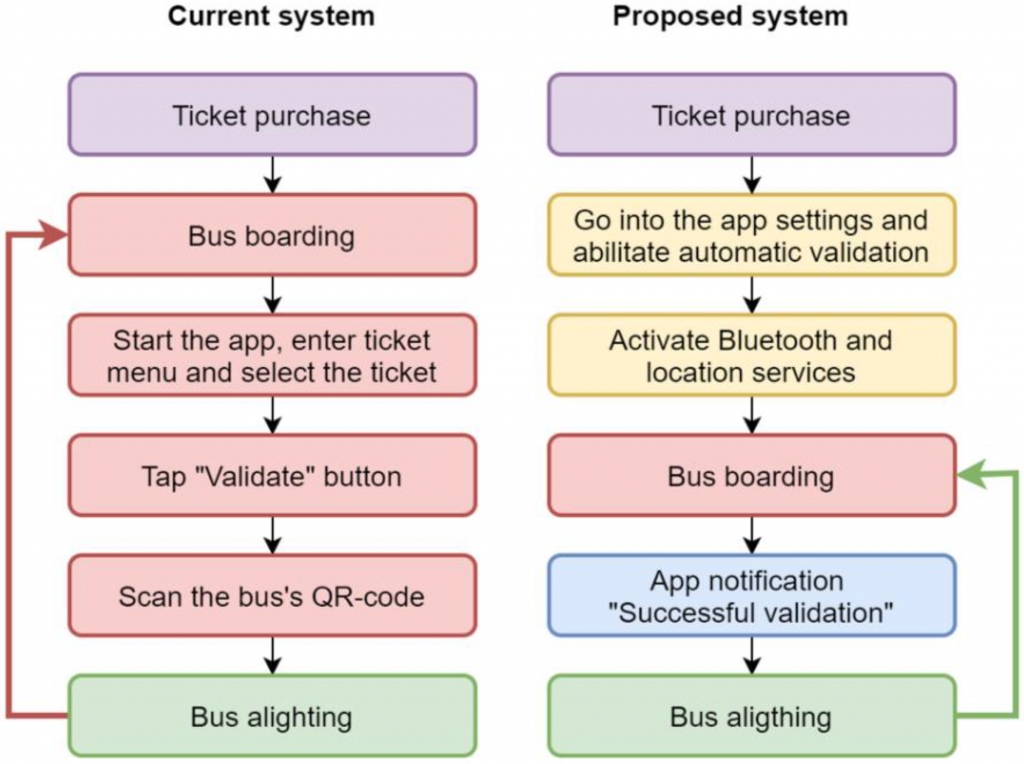
There’s new research from University of Cagliari, Italy on Beep4Me: Automatic Ticket Validation to Support Fare Clearing and Service Planning.

Integrated transport with single ticketing across bus, tram and train requires revenue sharing between service providers which, in turn, needs accurate usage data. Relying solely on user-provided data suffers from incomplete data because not all users always validate their ticket when checking out or when switching lines.

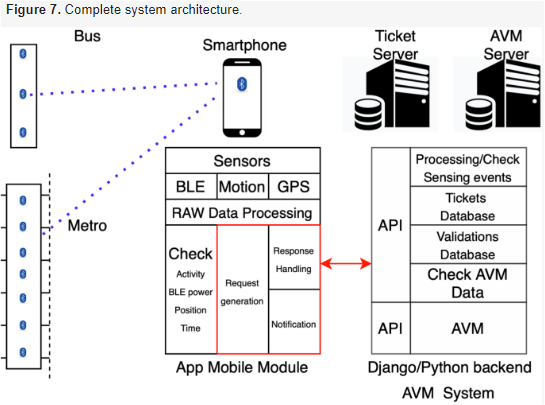
The researchers have created a system, Beep4Me, that collects usage data and interfaces with an existing mobile ticketing platform.

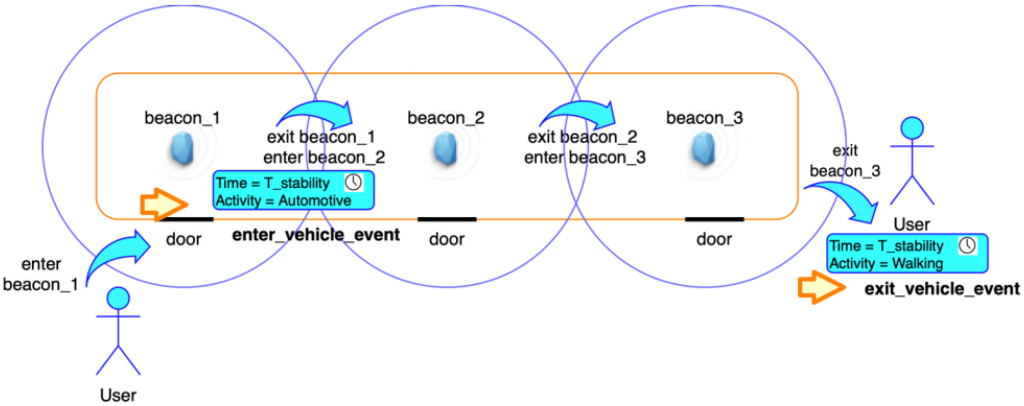
A smartphone app identifies the vehicle (bus, tram, or train) and automatically validates the ticket. It does this using Bluetooth LE beacons and location and orientation phone sensors to identify the patterns to clearly define modes of transport. Beacons are installed on buses:

The test data demonstrated almost perfect accuracy of event detection such as validation, transfer, choosing a ticket, purchasing a ticket and check-out.

Bluetooth Vehicle–Pedestrian Collision Warning

There’s recent research by Carleton University, Ottawa, Canada on Investigating Wi-Fi, Bluetooth, and Bluetooth Low-Energy Signal Characteristics for Integration in Vehicle–Pedestrian Collision Warning Systems.

The paper looks into the comparative performance of Wi-Fi, Bluetooth Classic (Bluetooth) and Bluetooth Low Energy (BLE) for integration in vehicle–pedestrian collision warning systems. More specifically, accuracy and functionality are considered with respect to signal strength indicator (RSSI) distance stability, rainfall effects on the signals, motion effects, non-line of sight effects and signal transmission rates.

The experiments identified the overall superiority of Bluetooth LE over Wi-Fi and Classic Bluetooth. Bluetooth LE provides fast collision warnings due to the frequent transmission and provides higher probability of simultaneous signal detection by multiple scanners.

The researchers say the results indicate the possibility of integration of Bluetooth LE technology in the design of vehicle–pedestrian collision warning systems in addition to currently used systems.

Using Bluetooth to Measure Travel Time

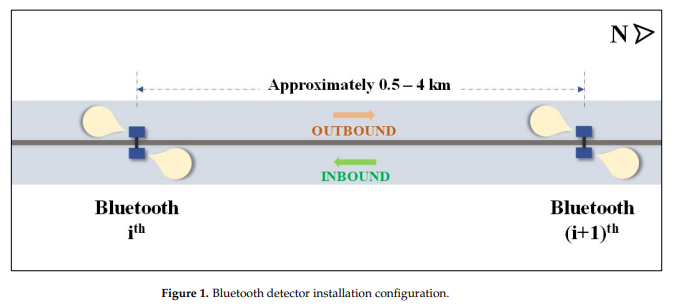
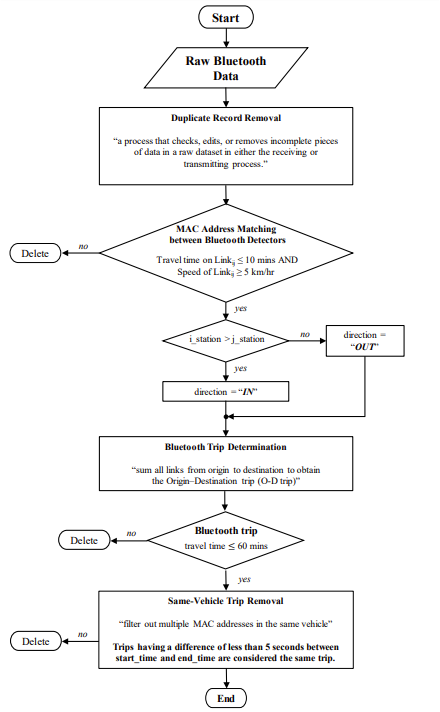
There’s recent research from Thailand on Evaluation of Bluetooth Detectors in Travel Time Estimation. The researchers looked into the feasibility of using detected Bluetooth devices to estimate travel time and assess the affect of vehicle speed on Bluetooth detection performance.

Bluetooth provides a compelling method because it’s already transmitting from smartphones, car stereo speakers, wireless headphones and other devices such that dedicated transmitters are not required. Bluetooth devices are also non-intrusive and more affordable compared to other types of traffic sensors and don’t suffer from low light and inclement weather as with the case with automatic license-plate recognition.

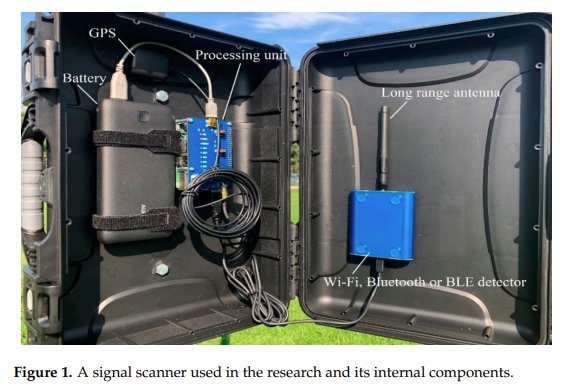
A 28 km toll section in Bangkok was used for the study. Bluetooth detectors and microwave radar devices, for comparison, were installed to collect traffic data. The data for 20-days, with 2 million Bluetooth trips, was processed in 5 ways to estimate the travel time.

The resulting Bluetooth trip data was compared with the traffic counts recorded by microwave sensors. For inbound traffic, the detection rates for the study area were in the range of 50–90 percent during the day and 20–50 percent during the night. Slower traffic during peak periods made it more likely for the Bluetooth detectors to detect MAC addresses.