Can I Use My Phone as Bluetooth Beacon?

A question that often arises is, “Can I use my phone as a Bluetooth beacon?” The answer is ‘yes’.

Before we get into the details, it’s essential to understand what a Bluetooth beacon is. In simple terms, a Bluetooth beacon is a small wireless device that transmits a periodic signal to other Bluetooth-enabled devices within its range. This technology is often used for indoor positioning, sensing and other location-based services.

Technically, yes, a smartphone can function as a Bluetooth beacon. Both Android and iOS platforms offer apps to turn your phone into a beacon transmitter. However, there are some caveats.

Using your phone as a Bluetooth beacon can be a significant drain on your battery. Beacons are designed to be low-energy devices that can run for years on a single battery. Your phone, on the other hand, has many other functions that consume power, so using it as a beacon will lead to the need for frequent charging.

The range of a dedicated Bluetooth beacon can be up to 100 metres, depending on the model and settings. A smartphone’s Bluetooth range is generally much shorter, limiting its effectiveness as a beacon.

While there are apps such as Locate Beacon, Beacon Simulator (for iOS), Beacon Simulator, nRFConnect (for Android) that can turn your phone into a beacon, these are often not as reliable or feature-rich as dedicated beacon hardware. You won’t be able to change all the settings such as power, advertising period and advertising type as you would with a dedicated hardware beacon. Additionally, running such an app in the background may interfere with other phone functions and some phones eventually close long running services.

Despite these limitations, there are scenarios where using your phone as a Bluetooth beacon could be useful. If you’re a developer or a business looking to experiment with beacon technology, using a phone can be a cost-effective way to test your ideas before investing in dedicated devices.

While it’s possible to use your phone as a Bluetooth beacon, it’s generally not the most efficient or reliable method for most applications. However, for personal use or small-scale use, it can serve as a convenient alternative. If you’re considering implementing beacon technology on a larger scale, investing in inexpensive dedicated hardware is usually the better option.
View Bluetooth beacons

What is the Difference Between iBeacon and Eddystone?

iBeacon, a standard developed by Apple, was introduced in 2013 as part of the iOS 7. It’s based on Bluetooth Low Energy (BLE), a power-efficient variant of Bluetooth technology. The strength of iBeacon lies in its background support on iOS devices, which allows for easier detection of beacons.

Google introduced Eddystone in 2015. This protocol for beacons was developed to embrace a broader range of uses. Eddystone offers multiple frame types to cater to various data needs like URLs, unique identifiers and sensor data. One most distinctive feature of Eddystone was the Eddystone-URL, where the beacons could send out a web address. However, this has been limited by the discontinuation of Google Nearby in Android.

Despite the differences in their design and features, both iBeacon and Eddystone share common ground in their use of standard Bluetooth advertising. They send different data in the same standard Bluetooth advertising packets. This shared aspect of technology ensures that they can both communicate effectively to both iOS and Android.

While Eddystone’s versatile frame types and open protocol initially made it appealing, it has seen a decline since the discontinuation of Nearby in Android. Currently, most new systems requiring smartphone applications to detect a beacon opt for iBeacon.

However, when it comes to locating and detection using gateways rather than smartphones, iBeacon vs Eddystone becomes less relevant and the beacons’ Bluetooth MAC addresses are usually used. The advertising packets can instead be used for sensor data, for example, temperature and humidity.

View iBeacon Beacons
View Eddystone Beacons
View Sensor Beacons

Can Bluetooth Beacons Track Individual User Data?

Bluetooth beacons themselves are generally not designed to track individual user data. They are small devices that transmit a Bluetooth signal at regular intervals, which can be picked up by smartphones or other Bluetooth-enabled devices within a certain range. The primary function of a beacon is to broadcast its presence and certain identifying information such as a unique ID.

However, the apps on your smartphone that interact with these beacons could potentially collect and store data about your location or behaviour. For example, a retail store might use beacons to send promotional messages to your phone when you’re near a particular product. The app on your phone that interacts with the beacon could collect data on which promotions you’ve seen, how long you spent in a particular area of the store and other information.

While the beacon itself is not tracking you, the software that interacts with it could be. It’s essential to be aware of the permissions you’re granting to apps on your phone, particularly those that request access to your location services.

The Manufacturer Site Says a Beacon Has a Particular Capability. Why Doesn’t the Version BeaconZone Sells Support This?

There can be several reasons why the specification for a beacon listed on our site doesn’t match that shown on a manufacturer’s web site or 3rd party sales platform.

  • Beacon descriptions on many sites are often written by non-technical staff and non-English speakers. This means that there can be misunderstandings and errors.
  • Some descriptions purposely over-fill descriptions with incorrect information or competitor’s product information so as to attract interest. The actual specification becomes clearer after you have asked the right questions or, in some cases, when you receive the beacons!
  • Some descriptions are of cloned products with dubious provenance rather than products from the original manufacturer.
  • It’s common for descriptions to mention optional features that are only available via manufacturing customisation. They are sort of saying the specification is possible, but you will find you have to pay a lot extra for a custom version.

We spend a long time assessing beacons and only list the features actually provided by the beacons we sell. We have a deep understanding of beacons that can be accessed via our support and consultancy services.

View Beacons

How to Read the AnkhMaway Sensor Data?

Since we have been selling the AKMW-iB003N-SHT  and AKMW-iB004N PLUS SHT we have been getting a few questions regarding accessing the temperature and humidity data.

You should first read the manufacturer’s SHT20 User Guide (username and password supplied with your beacon).

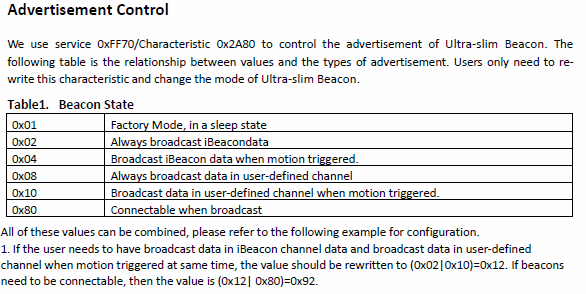
If you are connecting via GATT to read the sensor data then you will need to set the beacon to be always connectable. The way to do this is (for some strange reason) only shown in the iB001M user guide:

advertisementcontrol

So if you wish to transmit iBeacon and remain connectable, set the value to 0x82. Note that if you subsequently set the beacon ‘on’ or ‘off’ in the ‘simple’ configuration screen, accessed via the spanner icon (Android) or Configure option (on iOS), then this will overwrite your set value.

However, you might instead consider reading the sensor data from the advertising data which a) is much easier to program and b) uses much less beacon battery power and c) allows multiple apps to see the data at the same time.

There’s also an iOS example app in the BeaconZone AnkhMaway technical area.

Is There a Beacon That Works Without Bluetooth On?

We sometimes get asked if it’s possible that smartphones can detect beacons without Bluetooth being on. All beacons are based on Bluetooth LE that, in turn, relies on Bluetooth being switched on in the phone to scan for beacons. There’s no magic underling operating system mechanism on iOS nor Android that allows you to use Bluetooth without the user having Bluetooth on.

More users are leaving their Bluetooth on due to the proliferation of connecting with other devices such as cars, Bluetooth headphones and smart speakers. If you are writing an app you should take steps to detect if Bluetooth is on and prompt the user appropriately.

The phone and beacon industries need to better educate users that Bluetooth is no longer the heavy battery drainer it was in the early days of smartphones.

How Accurate is Bluetooth Direction Finding?

Bluetooth direction finding promises sub-meter accuracy. In practice, the accuracy varies depending on factors such as the locator hardware quality, radio signal noise, surfaces causing radio reflections, the accuracy of locator placement and beacon orientation. The sophistication of the location engine software in mitigating some of the aforementioned factors can improve the accuracy.

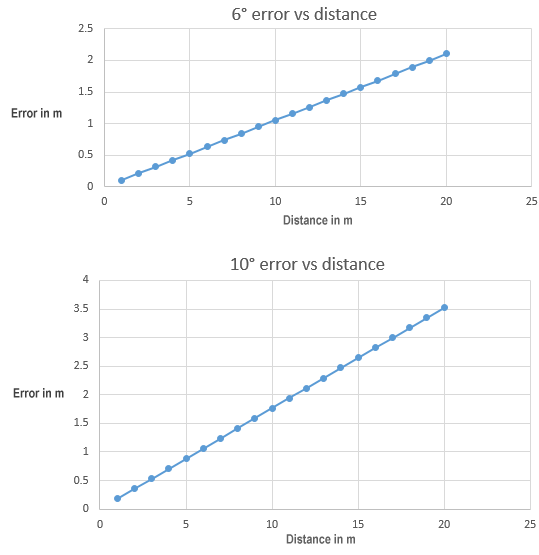
As a guideline, our Location Engine with the Minew G2/AR1 tends to find beacons with a maximum angular error range between 6° to 10°, depending on the above factors. The error in position due to an error in angle gets magnified with distance from the locator. Hence, the accuracy also depends on the distance between the locator and the beacon.

Here are graphs of error vs distance for 6° error and 10° error:

The above accuracies are for hardware such as the Minew G2/AR1 with PCB antennas 50mm apart. It’s expected that greater accuracies might be achieved with hardware having greater inter-antenna distances.

It can be seen that the sub-meter promise has caveats. We have some tips to help reduce angular errors. Averaging data, over time, also reduces angular error with the trade-off of increased latency of detecting location changes. As with all locating technologies, headline performance claims need to be carefully examined and are only achievable in particular situations.

Read about PrecisionRTLS™

Do You Have a Beacon That Makes a Sound When You Are Near?

The quick answer is no.

The longer answer is that beacons don’t know if anyone is near because they are not doing the listening. They just send out information. It’s possible to have a smartphone app see the beacon and the phone make a sound.

F6 Tracker Beacon

We also have special tracker type beacons to which an app can connect rather than just detect. Once connected, the app can cause the beacon to ring. However, only one app user can connect at a time.

What’s the Smallest iBeacon?

Small beacons are sometimes needed so that they remain unobtrusive or need to be embedded into larger devices. The smallest, cased, beacons we supply are:

The compromise with small beacons is that they have CR2032 batteries that don’t last as long as larger battery beacons. If the beacons won’t be moving and you have access to USB power, consider using USB beacons that are also small.